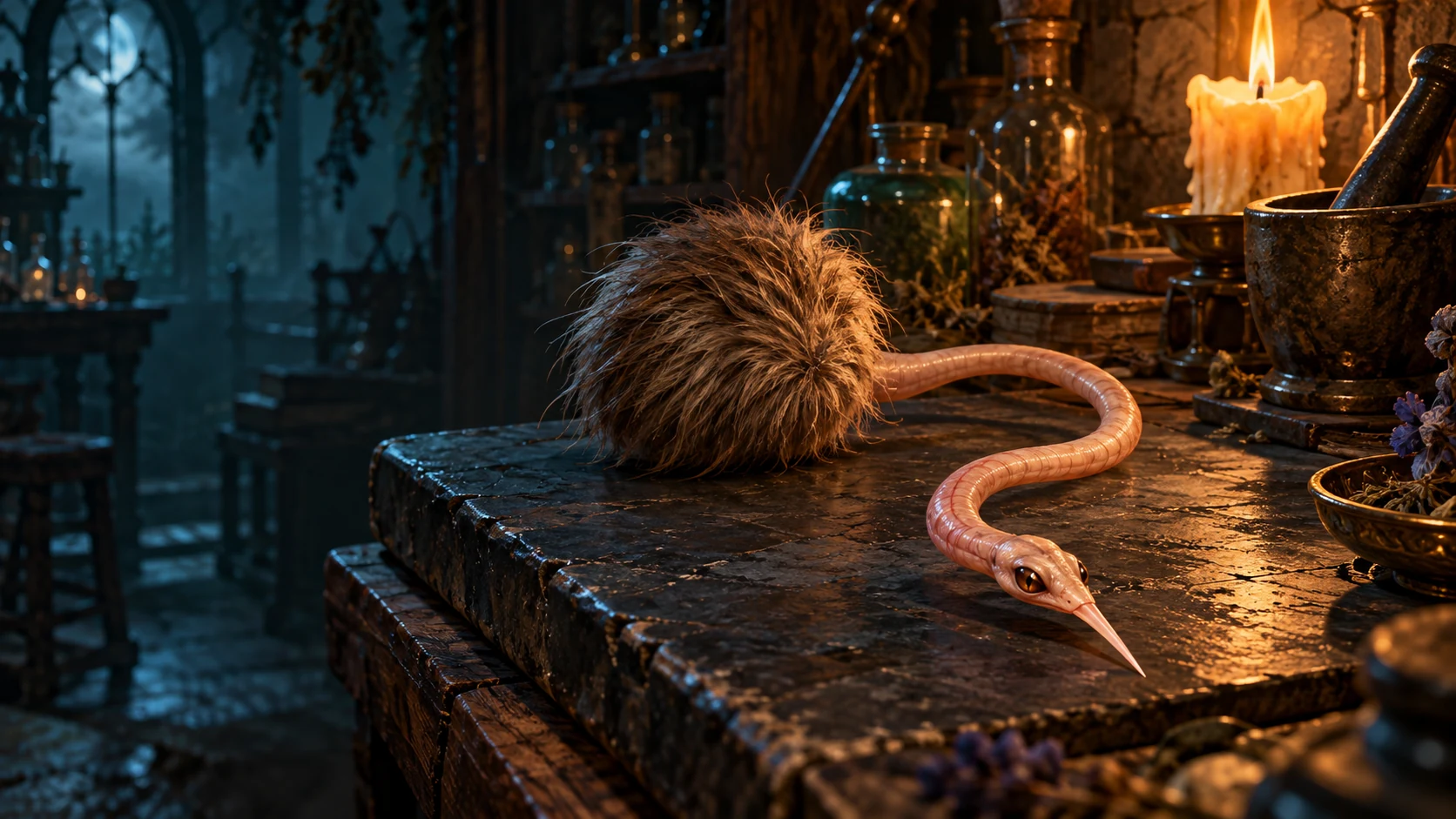
Replication, refusal, and removal
The instructions are invasive thoughts, not an automatic compulsion. A host can refuse. Track how many active fusions a person carries and give each one a distinct voice, rhythm, or repeated phrase so the players can recognize when another has joined.
Creating the demanded copies
Use this original ritual if you want a concrete procedure. A spellcaster who can cast at least one Transmutation spell of level 2 or higher can learn the replication rite from the rat’s intrusive instructions. It takes 8 hours, consumes 25 GP of materials per copy, and expends one spell slot of level 2 or higher per copy. One rite can create up to two copies.
The host need not perform the ritual personally. They can find someone with the required magic. Each new rat carries the magical signature of one particular parent. Two copies made for one parent cannot satisfy another parent’s demand. Each copy must actually fuse with a different eligible creature other than the original host; creating them in a cage is not enough.
Ending a fusion without spreading it
- Break the magic. A casting of Dispel Magic or Remove Curse targeting the host can end one chosen fusion without an ability check. This is a specific homebrew permission for False Rats, rather than a general change to either spell.
- Unweave the transmutation. A willing or Incapacitated host can undergo a 1 hour rite with a helper proficient in Arcana. The helper makes a DC 14 Intelligence (Arcana) check. On a success, one fusion immediately becomes inactive, and its tissue recedes over the next hour without producing copies. On a failure, the host takes 3 (1d6) Psychic damage, and that fusion cannot be targeted by this rite again until the host finishes a Long Rest.
- Fulfill the demand. Infecting two other eligible hosts satisfies one parent rat. That fusion disappears over 24 hours. This resolves the host’s problem by creating two more active parasites.
Three stranger ways to save the host
These cures exploit the False Rat’s narrow understanding of its own life cycle. They are original exceptions for this creature, rather than general rules for the schools of magic.
- Become an unsuitable host. If the victim’s Intelligence drops below 6, every False Rat on them realizes they can no longer propagate its species. The fused tissue separates, the rats drop off, and they scurry away. This can save the person at the core of a King in a single intervention. Restoring the victim’s Intelligence afterward does not reattach the departed rats; keep the fleeing creatures from reaching another eligible host.
- Drain its life or essence. A life draining or energy absorbing spell that transfers part of a False Rat into its caster confuses the parasite. It mistakes the shared essence for proof that the caster is the same being as itself: its two copies must already exist, and it must have completed assimilation. The chosen rat simply withers away after that one spell. For this homebrew cure, the caster can direct the spell at a particular fused rat despite its usual inseparability. Resolve any normal spell costs and effects; ordinary Necrotic damage without an actual transfer of life or essence does not create the required mistake.
- Show it two illusory copies. Illusion magic that presents two convincing copies of a False Rat fools its propagation instinct in the same way. Each active rat that can perceive the two copies believes the task is complete, withers, and disappears. The illusion does not need to infect real people. No additional saving throw or ability check is required for this creature specific solution once the spell creates the two visible copies.
A fooled rat’s demand ends immediately and it stops counting as an active fusion while it withers. These options also work on the rats making up a King. Describe the overlapping voices dropping out, one by one or all together, until the person underneath can be heard again.
The unweaving rite is also an original rule for this creature. Make its existence discoverable through notes, an experienced healer, or experimentation. Ordinary cutting cannot cleanly separate tissue that now belongs to the host; damage alone does not end the magical fusion. Changing appearance, resting, or healing hit points does not remove it unless a specific cure above says otherwise. If the host dies, its fusions die with it; a corpse does not produce new rats.
When the host becomes a False Rat King
Some people refuse every demand. Others cannot find the magic, or try to ignore the voice until it becomes part of everyday life. The situation changes when more False Rats find the same host.
Refusal starts a dangerous feedback loop. The host struggles against the first demand. More False Rats find an opening and attach, adding conflicting thoughts. Confusion makes it harder to fend off the next creature, which brings another voice, then another. There is no fixed count or timer. When this escalating infestation overwhelms the victim, people colloquially call the resulting abomination a False Rat King.
The attached rats have already shed their fur. The appendage is a knot of flesh that has become cellularly identical to the host, threaded with living serpentine bodies and eye bearing, pointed heads. It is not a furry rat pile. Each rat continues issuing its own demand for two copies. The voices interrupt and contradict each other, preventing the victim from making sense of what any one of them wants.
The victim’s distraction and confused attempts to resist give nearby False Rats more opportunities to attach. Its host can lash out at people who approach, interrupt the voices, or seem to threaten them. The resulting violence is a symptom of the entanglement, rather than proof that the person inside has become an enemy by choice.
Use the following block for an afflicted NPC. For a player character, keep the intrusive demands and physical changes as a situation the player can respond to; only replace their statistics or take away their control if you have agreed on that kind of story together.
False Rat King stat block
False Rat King
Medium Monstrosity, Unaligned
- Armor Class
- 13
- Hit Points
- 85 (10d8 + 40)
- Speed
- 25 ft.
- STR
- 18+4
- DEX
- 12+1
- CON
- 18+4
- INT
- 6-2
- WIS
- 8-1
- CHA
- 5-3
- Saving Throws
- Constitution +6, Wisdom +1
- Skills
- Perception +1
- Senses
- Darkvision 60 ft.; Passive Perception 11
- Languages
- Understands the host’s languages; fragmented telepathy 30 ft.
- Challenge
- 2 (450 XP); Proficiency Bonus +2
Traits
Afflicted Host. This stat block represents an NPC overwhelmed by an escalating accumulation of fusions after refusing their demands. There is no fixed number of rats or elapsed time that triggers this form; use it when the affliction has overtaken the scene. Record their original statistics. Track each fusion separately. Further attachments add fusions, not additional hit points or attacks. The host remains a person who can be rescued.
Conflicting Orders. The King has Disadvantage on Intelligence and Wisdom ability checks. Each fusion demands its own two copies, with no coordination between them.
Escalating Affliction. A host struggling with several contradictory demands becomes less able to notice and resist approaching False Rats. More can attach, adding their own demands. This feedback loop creates the King; it neither spawns rats nor compels a host to obey.
Break the Chorus. Removing a fusion uses the same procedures as for a single rat. When the last active fusion is removed, this form ends. Lowering the host’s Intelligence below 6 makes every rat detach at once. The life draining and illusion cures also work on its active fusions. The host is Incapacitated for 1 minute, then returns to its original statistics with current hit points equal to the King’s remaining hit points, capped at the host’s original maximum and with a minimum of 1. Preserve ongoing spell effects and ability score changes when restoring the original statistics.
Subdued, Not Cured. At 0 hit points, the host becomes Unconscious and Stable, and the King form subsides for 1 hour. After that hour, if any active fusions remain, the form returns with 1 hit point. Removing every active fusion during that hour ends it permanently; healing alone does not remove them.
Actions
Multiattack. The King makes two Fused Tail attacks.
Fused Tail. Melee Attack Roll: +6, reach 10 ft., one target. Hit: 8 (1d8 + 4) Bludgeoning damage. The King can push the target up to 5 feet directly away.
Conflicting Chorus (Recharge 5–6). Each creature of the King’s choice within 15 feet that has Intelligence 6 or higher must make a DC 13 Wisdom saving throw. On a failed save, it takes 7 (2d6) Psychic damage and has the Frightened condition until the end of its next turn, with the King as the source. On a successful save, it takes half as much damage only. This action does not attach or create a False Rat.
Run the encounter as a rescue
Show the escalation before the King appears. An initial voice makes a precise request. A second interrupts it. Later, the host repeats both instructions out loud, loses track of conversations, and notices other furballs beneath the furniture, their apparent tails turning to watch. With each new attachment, its fur drops away and another thought joins the chorus.
The King can be dangerous without making killing the host the only solution. Its attacks create distance. Its chorus disrupts a coordinated approach. Subduing it creates an hour in which the party can investigate and remove the active fusions. Lowering the host’s Intelligence below 6 frees them from every rat at once. Draining the parasites or showing them two illusory copies offers other ways to quiet the chorus without fulfilling its demands. A frightened ally who recognizes the host’s name can give the scene an emotional center.
A single rat’s suggested challenge rating does not measure the social cost of its bargain. Likewise, the King’s CR 2 is a starting estimate for this particular stat block, not a promise of an appropriate encounter for any party. The rescue objective, access to removal magic, and number of fusions can matter more than its damage.
An adventure hook: the healer who never has repeat customers
A town healer has a reputation for curing a strange growth that nobody else understands. Their patients leave looking well, but each has recently hired an assistant, invited two relatives to stay, or acquired an unusually large cage.
The healer has discovered how to perform the replication rite. They believe they are helping people escape a condition they cannot otherwise remove. Somewhere in the back room, a patient who refused the bargain has stopped responding to their own name.
Give the party a ledger of paired appointments, a scrap of the unweaving procedure, and a witness who remembers a furball becoming part of someone’s hand. Those clues point toward different ways into the problem. The important question is who the adventurers choose to help once they understand how the cure is being paid for.
Sources & further reading
Rules summaries link to their reference material. Character prompts, examples, and encounter outlines in this article are original DnD Lair ideas.

Creator of DnD Lair, DnD Survivor, and DnD Rouge. Writing about characters, encounters, and the ideas that make an adventure worth playing.