This article uses the 2024 revision of fifth edition. Specific features and spells can change the general rules, and older editions may differ.
The parts of a combat turn
On a normal turn you can move up to your Speed and take an action. A feature or spell may give you a specific Bonus Action option; it is not an extra unrestricted action. You can take at most one Bonus Action on your turn. A Reaction requires a trigger, and using it normally means waiting until the start of your next turn before you can take another.
Keep the official combat rules and Rules Glossary handy for exact wording. Read your own features closely, especially their timing and limits.
The helpful question is what your character can accomplish with those parts, rather than whether every possible part has been spent.
Name your goal before choosing an action
“I want the prisoner to reach the door” is a plan. “I guess I attack the nearest thing” might be a reasonable choice, but it can also hide uncertainty about what the scene needs.
Try giving yourself a brief sentence while the player before you takes their turn. Name the goal, the obstacle, and the tool you are considering. If the situation changes, update the sentence. You do not need to calculate an entire round in advance.
This also makes it easier to ask for a ruling. A DM can respond to a concrete intention more readily than to a long search through your sheet without context.
A rescue scene has more than one useful move
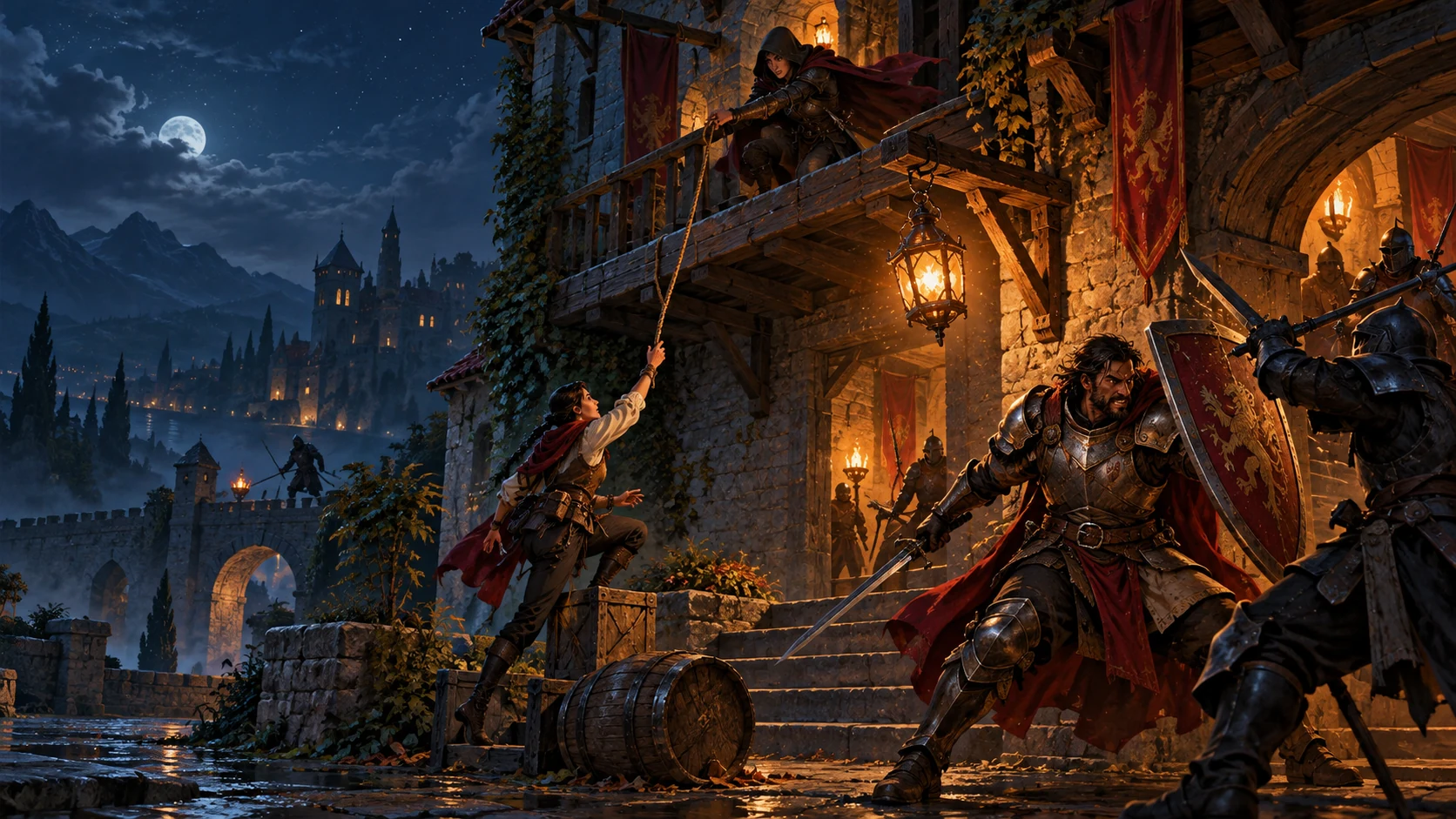
Consider a prisoner on a narrow balcony, a guard blocking the stairs, and a lantern rolling toward a curtain. The party wants the prisoner out before the room catches fire. Nobody needs to assume that defeating every guard is the only possible victory.
One character can deal with the guard while another reaches the balcony. A third can address the lantern or prepare the exit. Which actions actually resolve those intentions depends on the rules and the scene; describe the plan and ask the DM what it requires.
The important tactical observation is that the group has several bottlenecks. If everyone chooses the same bottleneck, the others still exist. A turn that makes the escape possible may be more valuable to the party’s goal than a turn that adds damage without changing the situation.
Read the part that tells you when it works
When you learn a feature, mark its timing, its target, its resource cost, and any condition it requires. If you tend to forget it, keep those details together on a small reference card. That is more useful during a fight than a page of disconnected keywords.
Do not assume a Bonus Action can be exchanged for something else, or that an unused Reaction lets you interrupt whenever you like. Follow the feature’s actual permission. If a rules question takes too long, the table can agree on a temporary ruling and check the source after the scene.
For spells, read the full casting time and relevant restrictions. A familiar spell name is not enough to know how its current edition works.
Use a short checklist, then pass the spotlight
- What is the party trying to accomplish in this scene?
- What changed since my last turn?
- Which reachable position helps my plan?
- What action am I taking, and is there a relevant Bonus Action?
- Is there a trigger I should watch for before my next turn?
Say your choice clearly, resolve it with the DM, and let the next player act. You can learn a great deal by watching what your allies try, particularly when someone notices a route you overlooked.
DMs can help by making objectives and environmental changes visible. If the party has no information about the balcony, the lantern, or the exit, it cannot make interesting choices about them. The encounter design guide builds on that idea with a complete original scene.
Sources & further reading
Rules summaries link to their reference material. Character prompts, examples, and encounter outlines in this article are original DnD Lair ideas.

Creator of DnD Lair, DnD Survivor, and DnD Rouge. Writing about characters, encounters, and the ideas that make an adventure worth playing.